Sunday, January 28, 2007

RMA

Name: Max

Age: 24

Occupation: student in NUS

Profile:

Max is a university student who is media- and tech-savvy. He professes to be "extremely attached" to his tech gadgets like laptop, digital camera, MP3 player and Xbox 360 game console, and claims he would "probably die" without them. With all his interest in technology, it is no wonder then that his area of interest in school is computer science, with a focus on interface (hence he can get rather anal about things with badly-designed interface).

Max is the eldest of 4 children and stays in the east side of Singapore. Hence he spends a lot of his time travelling to and from school via public transport, spending about a total of 3 hours a day commuting on the bus. He would rather do this than stay in hall because he believes he should spend time with his family every day. To him, people in his life are important. So apart from making the effort to stay home when he can to spend time with his family, he goes out with his close friends to do stuff together like play soccer or just go and "hang out".

As a hardworking and driven student who is gunning for 1st class honours, Max feels the constant need to be productive. He believes that good time management is essential, and that everything should be prioritised and organised so that there is maximum efficiency, then he can get as much free time as possible after focusing completely on his schoolwork. He is someone who definitely believes in working hard and playing hard.

Max is also a lover of music, and listens to many different genres. Often he can be seen "plugged in" to his MP3 player, especially when he does his regular jogs at east coast park on weekends. He is an avid gamer, and spends any free time he has playing sports games on his Xbox 360, claiming that it's his source of catharsis and relaxation. According to him, it's also because he gets an extra "kick" out of it because of the thrill of the games. Most of the time, he has enough discipline to know when to stop.

Some of his friends have been amazed at Max's ability to eat "anything". He isn't fussy about his food, and his favourite saying regarding this is "I don't care what it looks like. As long as eat already don't die then good enough" (i.e. He doesn't care what it looks like. As long as it's edible and doesn't kill him, he'll eat it). Some of this nonchalance is also evident when it comes to gadgets that Max gets. Things like size and colour of gadgets are secondary considerations to Max when he makes choices regarding his tech toys (unless they're in colours like shocking pink). To him, the functionality and features of any gadget, as well as the ergonomics of it are what matters (Max totally hates things that are badly designed ergonomically) , because he doesn't buy stuff because they look good or make him look good - he buys stuff to use it. Most of the time Max wouldn't splurge on a tech gadget unless he thought it was really worth it - so they have to have a certain appeal to him.

4-pleasure analysis:

physio

- Likes listening to music

- Keeps fit by running regularly

psycho

- plays sports games on his Xbox 360 to unwind and get a "kick"

- Likes to fiddle around with tech gadgets

socio

- Likes to make the effort to spend time with his family

- Likes to do activities like playing soccer with his friends.

- isn't image concious

ideo

- hardworking and driven

- efficient

- ambitious

- flexible and not fussy

- practical

- believes in the need for good design

- isn't a spendthrift


Product Benefit Specification (Aka a handphone for Max should have...)

1. many different functions

2. doesn't have to look fantastic

3. needs to be ergonomic

4. needs to have good interface

5. should not be too expensive


Reccommended product:

Nokia N73 Music Edition


Features:

  • has up to 2GB of memory
  • plays MP3s
  • can sync with PC to manage music
  • takes videos and photos
  • can share photos, photos and video can be edited either in phone or on computer
  • big screen with easily navigable user interface (according to nokia)

Sunday, January 21, 2007

Visceral, Behavioural, Reflective - a Reflection

your friendly UX designer was asked this week to go hunting around for examples of visceral (initial impact / appearance), behavioural (functionality), and reflective (message it gives about owner's taste). it has not been an easy search i can assure you (considering how each of them overlaps, and how the companies try to sell them with all 3 design emotions in mind)... but i've tried to find something (and hopefully its a good comparison)... and awaaaaaay we go!

Subject of comparison: LAPTOPS (i.e. laptop BRANDS and the images they portray)

Brands being compared: Apple, IBM (or is it Lenovo?) and.... Sony? (ok the last example was pretty difficult to find).

so now that we have the participants, let's play a little guessing game...

The Apple Macbook


"AHHHHH! MACBOOK BLACK!!!! I WANT!!!!"


I've had friends who've been DYING (and i do mean DYING) to get their hands on a Macbook, the black one especially. One particular one had this reaction when she saw a black Mac at the co-op "AHHHHH!!! i WANT!!!" which in my opinion is rather representative of most people who want a Mac (a rather insightful friend pointed out designers don't count. they use Macs for functionality, not cos it looks "cool"- you gotta be pretty "cool" to begin with if you wanna be a designer, so they don't need that extra boost).

So... based on the dominant reaction of all those people lusting after Macbooks (the black one especially), i'd say that the dominant design characteristic would be VISCERAL (though reflective could come in a close second because of the "cool" factor").

IBM / Lenovo


A quote from a friend about IBM / Lenovo laptops: "Reliable, no-nonsense and hardy. but its damn ugly lah!!!!"

Ok. After asking around for a few people's opinions, this is my conclusion about the impression (and "reputation) of IBM / Lenovo laptops: No-nonsense, reliable, can take all sorts of hits and maintain intact (i have a friend who's laptop has taken major abuse and still works pretty fine). Functionality wise, it comes with all sorts of stuff that you get with every other laptop, but is built to take more hits (and more importantly, survive them). So... i guess that would make it a BEHAVIOURAL-type design (i can't say much for visceral or reflective elements...)


Sony Vaio


the PC vs Mac vs Vaio advertisement (the "non-pc pc"? er... right. a PC by another shape or colour is still a PC):

So anyway... At first when i took a look at this ad (and the sony Vaio in general) i wondered to myself... is this more reflective? or visceral? I mean, i could easily file this under REFLECTIVE and end off my post, but i want to elaborate a little on the difficulty in this area (the other 2 were pretty much no-brainers). Reflective design is supposed to say something about the owner of the product, no? and the only way to get that across is to build brand image and perception. If that's the case, i can very easily just take one of those HP laptops as an example (especially with their "The computer is personal again" ads (which are rather well done i should think).

Then i realised unlike Visceral and Behavioural design, REFLECTIVE design is not only personal, but also a matter of how that perception is built (like through advertising). And I think Sony's above-shown ad would be an example of trying to push for the idea that it classifies as REFLECTIVE design in the sense that it makes you "cooler" than a dude who owns a mac (which would DEFINITELY say something about you).

Sunday, January 14, 2007

NM4210: Badly-designed Learning Report

If there's something i can think of that's badly designed, its definitely got to be the doors to those classrooms along the AS1 walkway.... and if you wonder why....

Most (or a rather large majority) of door handles are designed to be pushed down in order to open the door. The door handles for classrooms at the AS1 walkway however have to be pulled upwards in order to open them, effectively meaning that by pushing them downwards (like you would for normal doors), you're locking yourself out instead of opening the door.

This makes it a bad design in the sense that its non-conventional. I admit it's unusual (perhaps 'cool' even to some), but when you're late, rushing to a classroom and trying to open the door, the last thing you need is a door handle which doesn't follow the standard conventions.

I'm pretty sure most people who have had lessons in the AS1 classrooms have either personally experienced or at least witnessed a harrased student trying to rush into class, only to be unable to open the non-conventional door, which would probably lead to a lot of frustration for them because it makes them even later than they already are.

After a few unsuccessful attempts (and some help from students in the classroom), they would finally be able to open the door.... and probably learn that the door handle is supposed to move up instead of down. Since the door has no "brand", it would hard to actually figure out a user's impression of the brand (except maybe if you consider comments like "why on earth did anyone design doors like this?" to be a negative impression of the architecture firm that designed the doors).

So what do i personally think of this product (if you could consider it a product)? I think that while it seems like a unique idea, it is a bad design in the sense that it works totally opposite to conventional designs for similar items. People have conceptual (mental) models about how things should work (which generally are conventions followed by the majority), and if a design goes against these conventions and conceptual models, it will be difficult for people to understand and use these products.

As for the user reaction, i would think that it is normal and understandable. Given the circumstances where the evidences of this atypical and bad design occurs, they have every reason to feel frustrated. When someone is in a hurry or under stress, they rarely think about the exceptions to the rules (such as the way this particular door handle works), often resorting to those conceptual models they know and which have become habitual, so naturally they would try opening the door by pushing the handle downwards (and get frustrated when it achieves the opposite result of locking them out of the room).

Monday, January 01, 2007

oh WOW! DOTA!

i don't really post here much anymore (not since i ended NM3216), but as i've always said "There's some things you can never really run away from."

so anyway... had dinner with mum's side of the extended family, on the table with all the cousins who have a minimum age of 18 (going on 19). Funny how at one point the conversation swung in the direction of DOTA and WOW (like i said... there's just some things you can't run away from).

I found it funny how this particular cousin of mine has now become somewhat of a DOTA fanatic (when about this time last year i recall him saying he could never understand why all his friends were persistently playing that game).

Well one year on, and things certainly have changed haven't they? on an even more interesting note, there seems to be a little inter-family DOTA competition going on (where Dota-playing siblings team up against their similarly teamed-up cousins), and where they seem to be playing for bragging rights (like my cousin said, "We have t PWN them so that at the next family gathering we can rub it in their faces!").

The other topic of interest was WOW (World of Warcraft) - mainly because i brought up the recent Season 10 episode of South Park called "Make Love, not Warcraft". Its interesting to see how immersive the game is, and how people are aware the level of immersion can reach. My cousin said that when the original WOW came out, he "lost all his friends" except when it was tuesday night (only because the server is down for maintenence). Now that most of them hit level 60 or so, he's got his friends back (or at least till the expansion comes out some time this year). The most interesting bit of all i thought, was when he said that "there's no way he's going to start on WOW, because i know once i start i won't stop." Such is the level of immersion (the guys at Blizzard Entertainment are geniuses i tell you).

Friday, October 27, 2006

Cowboy X REDUX

hmm. so we've got some problems with the core mechanics of our game. as its been mentioned during a consultation session we had, the very nature of the core mechanic is what gives us problems. the whole premise about the game is controlling without giving the player control - and the lack of the player's sense of control is the biggest concern.

So its back to the drawing board for the crew of Cowboy X.

Stay tuned...

Thursday, September 07, 2006

The module formerly known as Gaming Culture 2

thought of the day:Game Design 2 (NM4209) - aka the module formerly known as Gaming Culture 2

Welcome to another entry in the blog of your friendly neighbourhood gamer. today we touch on... NM4209 - Game Design 2 (or more affectionately known to me as 'the module formerly known as Gaming Culture 2). it's been interesting these few weeks to say the least. considering how the module is now 100% CA (meaning we have NO EXAM!!!! bwahahahaha)... BUT, that also means we have to come out with a fully-developed game at the end of the semester (using the program known as GameMaker).

the friendly neighbourhood gamer has taken a crack at GameMaker, and come up with a very rough game of his own. its not fantastic, but at least touches on the basics of how the program works - its something like BreakOut.

so... ideas for the project revolve around Cowboys X (say it really quickly over and over....hahahahahaha). its a bit like a top-down version of Metal Slug-meets-Lemmings-meets-Sims. that's taking into account the 3 major aspects:

1. you go around killing people
2. there's no direct control over the character (which we shall refer to as Cowboy X)
3. you influence his survival is indirectly via strategically placing power-ups etc in his path as he goes on his rampage.

a few things to think about (which are nothing more than aesthetic elements till the final game is out):

1. 'customised' or varied character traits (ala RPG character creation).... which would mean you could have a super-conservative or even a super-reckless Cowboy X.
2. a level structure resembling 1.1, 1.2, 1.3, 2.1,2.2, 2.3 etc, with each sub-stage having a different objective.
3. variation of level objectives - play to time, play to kills etc

let's see how Cowboy's X (say it fast over and over... hahahaha) turns out at the end of the sem. should be quite a game.

Wednesday, July 26, 2006

The only game possibly played by (almost) the whole of NUS...

thought of the day: possibly the most perverse MMORPG ever (unintentionally) created...

ok. so i bet you're asking the friendly neighbourhood gamer how that is possible (THAT in this case referring to:
1. a game played by possibly the whole of NUS
2. the most perverse MMORPG ever (unintentionally) created

ready to find out more? and awwwaaaaaaaay we go...

just so that you know... before every semester begins, NUS students (most of them anyway) go through the wonderful practices of bidding for modules through the *cough cough accursed cough cough* system called CORS. since this blog is read most by NUS students anyway, i won't bother to actually go through the whole mechanics of it.

the friendly neighbourhood gamer has (as a result of having too much time on his bored mind) come to the conclusion that CORS essentially is like a MMORPG (Massively Multiplayer Online Role Playing Game) which coincidentally involves the whole of NUS (ok fine most of it, saving the prescence of medicine, law and dentistry students). in short, CORS is a perverse version of World Of Warcraft or Maple Story (i'm soooo gonna get bombed for this).

now before you (and the rest of your angry mob) decide to drag me off to burn me at the stake for heresy, HEAR ME OUT. Do you not agree with the following:

1. Just like in any other game there are veterans (read: seniors) willing to help out n00bs (read: freshmen and whoever else can't figure out the system). Seniors not necessarily referring to those who are older, but those who have more skill at the 'game'.

2. it involves a considerably large population being online and interacting
with one another through figurative battles (read: throwing bid points to kill
each other)

3. people band together to form teams / guilds of sorts (read: you gang up with your 'kaki' to take the same modules and watch each others' back during bidding rounds)

4. it contains elements such as challenge, risk vs reward, resource allocation, strategising etc

5. someone should write a guidebook / walkthrough on how to surive the horror of CORS bidding (maybe i should do it... i've been asked quite a few times)... i mean, there's books on how to excel at WOW right? ok so maybe if no guidebook the seniors are like some real-time customised CORS FAQ forum.

6. you gotta pay to play

ok if you don't agree with ALL of the above, THEN you can burn me at the stake. if not, shut yer trap (and put down that pitchfork - you could poke someone's eye out with that).

the only difference between MMORPGs like WOW or Maple Story as opposed to CORS is that in those MMORPGs you can sell your in-game currency, or whatever items you purchased. unfortunately, the same can't be said for CORS. i bet everyone in engine wishes they could sell their points. selling modules? now there's a thought. imagine flogging NM1101e on ebay.

so yes that comes to the end of my ranting. this is your friendly neighbourhood gamer, signing out.

Saturday, June 10, 2006

outside of normal time?

ok i know this is weird (it IS a homework blog after all), but i'm actually voluntarily posting today (hard to imagine, no?)

anyway, i've been given the task to come up with some games for my church retreat (me and my big mouth about taking gaming mods). sad to say i didn't manage to come up with anything from scratch (instead 'kopping' games from some other camps i've been to).

and before someone decides to kill me with the "but i thought you spent a whole semester learning how to develop games, how can you NOT come up with any of your own" argument, i must say that i still do remember some stuff (like how i was explaining flow and positive feedback to my friend in the course of rationalising why i couldn't implement certain rules though i thought it would make things more interesting).

and here's the gist of it...

i'm sure most people know the newspaper game. you know, the one where everyone tries to squeeze onto a sheet of newspaper and every so often the paper gets folded into half? well i wanted to use questions as a means to get the newspaper folded. answer wrongly and your newspaper shrinks. answer right and well... nothing happens. its 2 groups competing against each other, so that makes things interesting.

so then i thought of this brilliant 'double or nothing idea'. your group gets a hard question. the decide to go for a double or nothing by throwing it to the other team. they get it wrong, and their paper gets folded in half. they get it right, and your newspaper becomes 1/4 its original size (in other words double penalty. 1/2 of 1/2 is 1/4). this obviously leads to too much positive feedback (i'm guessing most of you should be able to see why).

so yes, believe it or not, i've been having to apply this stuff outside of NM3216 (in a camp no less). at least its something usable, unlike other stuff (which i'm not implying isn't. just that its not as usable).

Tuesday, April 04, 2006

Newgrounds.com 'Problems Of The Future, Today!"

topic of the day: case for the digital game

welcome to another entry by your friendly neighbourhood gamer. today the topic is the digital game. and my example is crazy steven, a rather violent and gory game from newgrounds.com (my favourite haunt. it really IS very good for getting game examples).

so what's the core mechanic for this game involving a psychotic sword-wielding fireman who rides a flying magic donkey and goes on a killing spree? well, by conventional game genre standards, crazy steven would be considered a side-scroller, where there's the element of continuous motion and changing landscape (think like a cinema reel thing). not to mention the element of response time and reflexes.

and speaking of cinema reel style, that's one way someone would (try to) convert it into a board prototype. the only problem being that it would be SUPER-slow (if the minimum specs for crazy steven were pentium 5, then it MIGHT run at 386). and the fact is that the obstacles and targets are continuous. a bit hard to co-ordinate if you ask me. especially when you've got to collect some (like cash and timers), kill others (like people) and avoid the rest (like fallen trees and concrete blocks). all those aspects would make crazy steven a nightmare to prototype / simultate. and that's it i guess - the fact that you need the computer to do the processing at a reasonable speed in order to have the desired experience (especially when it comes to response time and reflexes).

then again maybe i should try a real life simulation to see how much the game is able to translate. the only problem is that now i need a sword, a fireman's uniform and a magic flying donkey.

p.s. the friendly neighbourhood gamer bears no responsibility whatsoever for any crazy fool who decides to undertake the suggestion mentioned above (assuming he / she can get his / her hands on a magic flying donkey of course).

p.p.s. this kinda goes back post title. except that the problem of a sword-wielding, pyschotic fireman riding his flying magic donkey and killing people is not a problem in the near future (i hope). not till someone can get donkeys to fly anyway.

Monday, April 03, 2006

Seriously speaking

yes. i have lots of catching up to do. lagging quite badly actually. but we'll get there. somehow.

topic of the day: you can't be serious...

today, our friendly neighbourhood gamer reports on serious games. what's that you say? serious games? isn't that a paradoxical situation?

but yes. seriously speaking... there ARE serious games out there. like 'the McDonalds game'. its basically a game where you take control of 'the evil corporation' that is McDonalds (if you don't believe me, check this out - proves that not just the creators of the McDonalds videogame have that sentiment).

so the game aims to 'educate' players about the fast-food industry (i put the inverted commas for the simple reason that throught the gameplay you can more or less deduce their intended message and views).

so does it pass the test of being a good game? not really. its more of a sim rather than an actual game i think. there isn't much of a win condition per se. the only goal you have is to not go broke. the fact that in attempting to do 'bad' things to increase your profits result in more negative effects, your options for gameplay are rather limited in that sense, even though you get to control the various aspects of running a fast-food corporation. most of the time when you play you're more into survival than maxing out profits. so the fact that it perpetually frustrates players (i had to experiment with it for hours before getting an 'equilibrium' situation) doesn't make for very good gameplay.

as a serious game (trying to spread a message / educate people), the message doesn't quite get across either. they don't explicitly tell you what they're trying to say (then again if they did then they could get sued by the golden arches). that's the problem with an implicit / indirect message - not everyone will get it. and that's why it will not really succeed as a serious game (the bad gameplay might actually turn players off before they can understand the intended message).

and with that, your friendly neighbourhood gamer gives the mcdonalds game 3 out of 5 stars for its success rate.

Sunday, March 19, 2006

Social Games?

before we begin, its quite obvious this blog has been neglected for a while. ironical considering it counts towards the grade.

topic of the day: games with the social premise...

today our friendly neighbourhood gamer presents his long-overdue viewpoints on the phenomenon known as social games (more specifically, Little Max and mafia). incidentally both games are variations of existing ones (but aren't all games?) - little max is the dice version of bluff, and mafia's just another version of polar bear.

but anyway... back to observations and viewpoints. our gamer noticed that social games (such as little max and polar bear) have elements of social interaction (which somehow brings to mind a question - don't ALL games involve social interaction?). The whole premise behind mafia and little max is the idea of deception - in mafia trying to convince people that you're not who they think you are, and in little max basically whether you're just bluffing to survive.

so what happens in the whole process of social interaction? you tend to start to make judgements about people, based on how they interact with others involved in the game (like how everyone has associated wei ren with being a good liar to the point they don't want to believe him anymore - even when he's telling the truth).

and since the nature of both games depends on how well you can convince others of a particular viewpoint (in order to ensure your survival in the game), "people skills" become important. the ones who have more are better at it, the ones who have less (and don't speak up to defend themselves during accusations) are more easily eliminated (and when they make the mistake of wrongly eliminating a quiet person, one question that never fails to arise is : why you never defend yourself?!). but that's what social games are about right? interacting actively with other game participants.

here's a thought about gamer classification - gamers in little max and mafia probably fit the standard player type (then again it really depends what you deem to be 'standard' player type), since everyone more or less plays the same style (especially for little max, considering there's only 1 way to play the game. unlike bluff you can't resort to telling the truth all the time - the dice rolls don't allow for it). but i guess maybe cos we're playing among friends (or at least people who we're somewhat familiar with).

here's another thought (this one about mods): what if you modified little max such that you HAD to tell the truth? like say we had an "immunity" thing. then whoever had it die-die had to tell the truth and show his dice roll (but wouldn't get eliminated since it was immunity), and the value was reset from there? what effect would that have on the game do you think? of course it could be good or bad depending on what happened, but most likely it'd be a help than a hindrance (unless of course the guy with immunity called a double-6 - then the next guy would be really in for it). would be interesting don't you think?

this is your friendly neighbourhood gamer signing off...

Thursday, February 09, 2006

Mmm-MONSTER KILL!!!!

topic of the day: Can you say "BEYOND GODLIKE"? *grin*

today we'll be taking a tour of the warcraft 3 modded map everyone loves: DOTA! so throughout this tour we'll be covering several areas, to understand better the elements of this great game... so strap in and allow your friendly neighbourhood gamer to give you a guided tour... and awaaaaaay we go!!!

if you look to your left, you'll observe the formal elements of DoTA (but first a little history)

DoTA is a team game - 2 teams (one plays "The Sentinel" and the other plays "The Scourge") facing off against one another in a race to destroy the other team's "Ancient" (DoTA stands for Defense of The Ancients after all).

team sizes go all the way up to 6 v 6, with each player controlling their own unique character (or hero) which learns skills and 'levels up' the way that heroes in RPGs do. most characters are classified into 3 kinds - Agility, intelligence or Strength heroes, each with different abilities.

in addition players are allowed to buy items (and combination of items) which boost their attributes in different areas such as attack damage, attack speed, as well as the standard 3 attributes.

right. now onto the concrete stuff...

PLAYERS

players are divided into 2 teams, size ranging from 3v3 to 6v6. there is no requirement that teams should have equal numbers on both sides, though it is preferred for a "more balanced" game (in terms of absolute numbers).

since the map is divided into 3 "lanes" for players to travel through, depending on the number of players (and the type of heroes used), team members then take a lanes to advance in order to destroy the other teams Ancient.

based on heroes used (as well as the individual player's perceived skill level), he / she often will decide if he wants to do a 'solo' (travel the lane alone) or go with other team members. i'm under the impression that guys who request "solo pls" are arrogant jokers who think they're really good (though some heroes are better at solo-ing, and that's agreed by most DoTA players).

would the number of players change a DoTA game's dynamics? DEFINITELY. a common phenomenon in such games is "leaving" (which is the most irritating thing ever), where players just quit the game. i've observed my brother play on battlenet, where a 6v6 degenerated into a 2v4 (himself being one of the 2). and because of the numerical disadvantage, the major strategy went from "pushing" (going on the offensive) to defending the enemy on the doorstep (rather frantically i should add). i think they were pretty successful considering the whole game lasted 1 hour longer than most games.

but that's for multiplayer over a network. recently there have been AI maps where bots can play as your partners. granted they're pretty stupid (it is ARTIFICIAL intelligence after all), there perhaps is less of a challenge for a player who's up against bots. i play AI for fun, and realise that the different difficulty settings just mean that they push the lanes faster rather than the bots becoming more intelligent. so bearing that in mind, turning DoTA into a single player game just makes it one where there's an element of predictability in terms of knowing how the AI responds and acts.

Objectives

the objective of DoTA? destroy the other team's ancient (like i said earlier... DoTA = Defence of The Ancient). that more or less means destroying everything the enemy has in the lane... from defence towers right up to the whole base (since the Ancient is dead smack centre of the base).

although that is the official end-game condition, i've seen people come up with other objectives. the main one being hero killing - racking up the highest number of kills (you get certain kill status if you rack up a consecutive number of kills, eg. 10 straight kills and there's an announcement that you're BEYOND GODLIKE - and an in-game voiceover goes "HOLY SHIT")
procedures

players level up by killing either enemy heroes or 'creeps' (think pawns in chess). the more they kill the more they increase their stats, allowing them to learn special abilities which require mana, or those that increase certain attributes.

rules

1. players have to destroy the other team's "Ancient"

2. players are allowed to destroy opposing team units in the course of attempting to destroy the ancient, and this includes both heroes, creeps and defence towers.

3.players may not attack either creeps, heroes or defence towers from their own team

4. players are allowed to purchase weapons and combination of weapons or items that boost their attack damage or other attributes.

5. items which have 'orb' effects are non-stackable, meaning if you have 2 items - one which has 'life steal' and the other 'desolate (which reduces armour of person being attacked)' both effects cannot be used simultaneously.

6. players can level up their heroes stats once he has sufficient experience points, which are gained by killing enemy heroes and creeps.

7. when a player's hero is killed, there is a cooldown period before respawning. the higher the player's level, the longer the re-spawn time.

Resources

Players are allocated a specific amount of gold which can be used to purchase various items. gold can be earned by killing heroes, creeps or by destroying structures such as defence towers. players are also allocated gold over time periods (like 8 gold per second i think).

the heroes that players use have their stats as resources - ranging from attack damage, armour, agility, strength and intelligence. players' heroes are also given a certain number of hit points and mana (which can increase with each level-up or depending on what enhancements they purchse for their character). mana is used for spell-casting which often results in various effects or damage to opponents or allies, and many spells are unique to each hero.

Conflict

DoTA conflict arises between players from opposing teams generally speaking. sometimes it occurs between members of the same teamin instances where they do not follow team instructions (hence getting themselves killed). this is where all the taunting and insults come in. especially if your teamates are 'NOOBS' or 'leavers'.

Boundaries

DoTA boundaries basically are limited to the map.you cannot go beyond points that are outside the map area. players' heroes can only see a certain distance in front of them (fog of war) though they can see what their team mates or creeps see (basically they can see anything an ally sees).

Outcome

The outcome of DoTA is the declaration of the winning team after the end-condition has been satisfied. most of the time players are able to guess which team is about to win (based on the number of kills the team has in total, since if team members are pretty much always dying then there's no one to do the defending).

and that concludes our tour of DoTA.

can you say "OWNING?" *grin*

Friday, February 03, 2006

trading poker

here's a game idea that combines poker (sort of) with a element of trading resources.

equipment: 1-2 decks of playing cards (2 decks if more than 4 players)

players: 4-8 players

objective: build a 'flush' / 'straight' of the same suit (e.g. 10, jack, queen, king, ace all SPADES)

rules:

1. each player starts off with 10 cards, and whatever balance goes into the 'resource' pile

2. in order to build their flush / straight, players are allowed to trade off "excess" cards (they need a minimum of 5 to build a straight / flush)

3. players can obtain the necessary cards by trading with either the resource pile or other players.

4. when trading with the resource pile players are allowed to shuffle the pile and then take the top-most card (s). in order to obtain 'n' number of cards from the resource pile players must return n + 1 cards to the pile (e.g. if you take 2 from the pile you have to surrender 3 cards to the pile).

5. in the event that a player has the minimum number of cards (5) in his / her hand and wants to trade with the resource pile, he or she has to trade at least 2 cards into the pile. (so if you have 5 cards in your hand and want to trade with resource pile, then you have to exchange at least 2 cards in your hand for the corresponding number from the pile.)

6. when trading with other players, players are only allowed to indicate which suit they are looking for, not the specific card (so you can ask to trade for diamonds but not ask to trade for 7 of diamonds).

7. the number of cards players trade is up to them to negotiate. it is not necessary to have a 1-to-1 exchange or a n-to-n+1 exchange.

7. cards being traded do not need to be of the same suit (you don't have to trade 1 diamond for 2 clubs. you can trade a diamond for 1 club and 1 heart for example).

8. first player to build his / her "flush" or straight wins.

9. when a player is 1 card away from a flush / straight he or she has to declare himself / herself as "1 away" (as in 1 away from completion).

10. in the event that 2 players manage to complete their sequences at the same time, the player with the "higher" sequence will win the round (e.g. a royal flush will beat a 6-10 straight). should players be playing for points, a royal flush would be worth 2 points instead of 1.

optionals / exceptions:

1. players are allowed to 'wash' their hands by mixing their cards into the resource pile and drawing out the same number of cards they put in (so if you have 10 cards in your hand and decide to 'wash' it, then after shuffling your cards in the resource pile you draw out 10 cards for your hand).

2. washing can be done up to a max of once per player per round.

3. in the event that a player is dealt a flush / straight in the opening hand of the round, he / she has to declare it and then 'wash' his / her hand. this mandatory washing does not count towards the quota.

Sunday, January 22, 2006

Game On...

topic of the day: game on!

alrighty then. today's post is about *cue scary music* ASSIGNMENT 1!!!! egads! so early on in the sem and we've already hit the first assignment. oh well *shrug*. in other news, the NM3216 checking-if-a-game-really-qualifies-as-a-game committee will convene for a meeting to discuss whether the new sport called CALVINBALL meets the requirements to be considered a game. and awaaaaaay we go...

1. the case for calvinball as a game...

the checking-if-a-game-really-qualifies-as-a-game committee has convened to discuss the fate of calvinball, a 'game' created by calvin of 'calvin and hobbes'.

to determine if such an activity can be considered a game, the committee has been asked to compare the activity against a checklist of criterias set forth by gaming expert Eric Zimmerman. we now go live to our gamer on the scene...

here's your friendly neighbourhood gamer reporting live from the NM3216 checking-if-a-game-really-qualifies-as-a-game committee meeting. apparently there has been much discussion about whether the activity called 'calvinball' can pass the criterion to be considered a game.

this gamer understands that calvinball will be judged on the following criteria:

a) whether it is voluntary
b) whether it is interactive
c) whether there are players
d) whether these players follow rules that constrain their behaviour
e) whether conflict exists
f) whether there is a quantifiable outcome

based on the description and basics of calvinball, the committee apparently has accepted that calvinball indeed is a voluntary interactive activity between players (hence meeting criterion a to c). however the committee has reached some disagreement regarding the very questionable criteria d. according to the official calvinball rulebook, one of the major clauses reads as such:

"IMPORTANT -- The following rules are subject to be changed, amended, or dismissed by any player(s) involved."

in interpreting this clause, the committee has agreed on the 2 possible meanings:

1) calvinball has rules that are not entirely binding (owing to the fact that most - if not all - are subject to change based on players' whims)

2) by saying that rules can be changed / discarded or created, the implication that the only rule is that no rules are fixed (thus possibly saying that calvinball has NO rules). if the committee were to take this stand, then calvinball would be possibly marked down for failing to meet one of the major requirements of what constitutes a game.

another rule of calvinball which has caused some disagreement among committee members is the one which states that: "Any rule above that is carried out during the course of the game may never be used again in the event that it causes the same result as a previous game. Calvinball games may never be played the same way twice"

this rule effectively states that the activity 'calvinball' when played multiple times may not be indentical in any way. however this gamer understands that such a condition may cause confusion among players of calvinball, since no one can readily agree on the basis of how it should be played.

calvinball has also been failed on criteria f), on the basis that scorekeeping is optional. this gamer understands that the option of not keeping score in a game of calvinball makes the possibility of it having a quantifiable outcome questionable. this gamer also understands that the absence of a quantifiable outcome (and thus implications of the 'game' being without purpose), essentially calvinball can be parallelled to "people running around like headless chickens" as quoted from a committee member. this would make the presence of meaningful play in such an activity questionable.

this is your friendly neighbourhood gamer signing out.

GAME OVER...

Wednesday, January 11, 2006

Games People Play...

topic of the day: playing around...

Here's some things to think about:
1. what is a game?
2. what makes a good game?

so maybe these are things that most of us (gamers or otherwise) take very much for granted. to us, games are just, well, games. and most of the time all we do is play 'em. but after this IS gaming culture. so we need to know about games, what makes them what they are and why we like them so much. so without further ado, let's get to the questions... and awaaaaay we go...

1. what is a game?

we never really think what games are. games are what people play. for fun, for enjoyment, for a challenge. but games are, according to some experts, interactive systems where the element of play is conducted within boundaries. think about it - games have rules, restrictions and other such things. yet at the same time, there is spontaneity, room for people to do different things within the rules. and that's why (most of the time) games sre different every time you play them (of course that doesn't happen in lousy games, but we'll get to that later).

and of course there's the interactive element to games. where there is a communication relationship between either people and computers or people and other people. and that's what makes games interesting and varied. the interactive element.

so let's recap: games have rules. games are spontaneous. and games are interactive.

and with that, we move on to question 2: what makes a good game?

there are good games and bad games, fun games and boring games. games that you can't stop playing even when you've completed it, or games that suck so bad that you don't bother trying to complete them. having said all that... what IS a good game made of? what makes DoTA (or even old-school games like snake or pong) so addictive?

i guess one way of assesing how good a game is using the above definition i've provided.

rules / boundaries / restrictions

a good game has clear rules and is challenging (but not too challenging). these are the boundaries that exist in games. they restrict what users can do and provide players obstacles to overcome. games like tetris have rules (like how your bricks can only disappear when you make a complete row) that restrict the player, forcing him to work within the boundaries that the game gives.

spontaneity

good games have an element of spontaneity. which basically would mean the player has the ability to manouvre within the set boundaries of the game. players like to experiment. they like games that give them opportunities to do things, not have to completely follow the preferrred path set out by game designers (its like how in DoTA though you will by destroying the other teams ancient you can do it after destroying the defence towers, or alternativelyjust bypassing them and charging blindly into the base to attack the ancient).

interactivity

in the case of games, interactivity and spontaneity overlap. because interactivity indicates that there is some semblance of spontaneity. good games are highly intearactive, in the sense that they promote inteaction among players, or have AI good enough to cponvince players that there is a high level of interactivity present.

that's why many MMORPGs and multiplayer games are such hits. because they allow interactivity among users (like in WOW or DoTA). these kind of games pit human players against one another (creating an element of spontaneity and unpredictability - much better than playing against an artificial intelligence someone programmed). so even in single-player games, the element of interactivity has to exist at a high level for it to be considered a 'good game'.

other elements to consider

though the above 3 criteria may be a means of judging what makes a good game, there are some other criteria to consider. one of the most important being replay value - an important aspect in single player games especially. games that you just play once and never pick up ever again after completing them rarely are considered to be good. replay value means you can play those games over and over and not get sick of them at all.

so that' s it. the definition of what a game is, and what makes a game good.

GAME OVER...

INSERT COIN (to continue)...

NEW sem. NEW module. but same old style *groan*

so yes for this sem, i'm being cheap and re-using this blog (formerly for 2217) for my NM3216: GAMING CULTURE 1 (wooohooo!!!)

anyone who's seen my postings last sem ought to understand my style - lame and crappy. but what the heck. makes life interesting, no?

so anyway... enjoy what you read...

and awwwaaaaaaaaaay we go!!!

Wednesday, October 19, 2005

Wanna Play?

topic of the day: ambiguity and the paradox of play...

ok i must firstly confess... i DIDN'T do the William Gaver reading... (i confess... I'M SORRY!!!!!)

anyway, since i can't make up anything about mr gaver's article (without feeling guilty)... i shall just jump straight into Zimmerman's "Narrative, Interactivity, Play and Games"

Mr Z (i'm too lazy to type the full name *grin*) claims that games are narrative systems i.e. they have have 'storylines'. and as always for everyone who comes up with a theory (just like the way Mr Z did), there are detractors who think he's wrong.

The claims are that games like tetris (which fits the definition of a game basically because they have rules, clear goals and a winning / losing condition - which is a perfectly fine one by the way) have no narrative system.

but since, like many things, definitions can vary, Mr Z's own definition is as such: "A game is a voluntary interactive activity, in which one or more players follow rules that constrain their behaviour, enacting an artificial conflict that ends in a quantifiable outcome".

as we can see, the definitions do vary. Mr Z's detractors have a more descriptive and functional definition of games, whereas Mr Z has what is a more human-oriented definition.

ok, before we swing off tangent here...

I'm inclined to agree with Mr Z. After reading about his narrative system explanation of Ms Pac Man (which sounded so PHILOSOPHICAL), if you go along the same lines, it IS possible to use this framework to define Tetris with Mr Z's definition (ridiculous as i think it sounds).

So let's take Tetris. you COULD say it's about life and death, and everything fitting nicely together (well that IS the aim of the game). It's also about not panicking under pressure (since the blocks come down faster and faster at the higher the levels you go).

So ta-da! there you have it. Narrative system applied to Tetris (somehow i think it isn't very convincing).

Wednesday, October 05, 2005

of screenshots and interactivity...

topic of the day: static screenshots... just imagine they're gonna move (or supposed to anyway)...

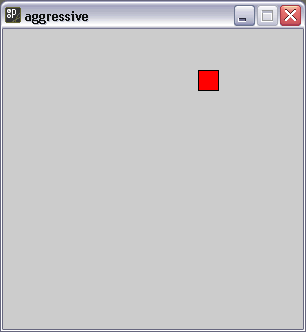
screenshot1: aggressive mode (even though it's a still... imagine the red square wobbling)


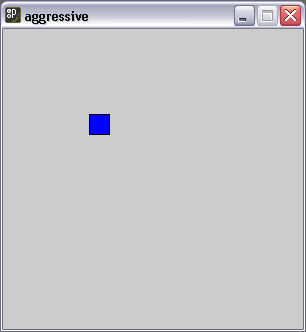
screenshot 2: passive mode (even if it isn't moving... it's supposed to move slowly towards the bottom right corner)

with regard to how interactive the object is (which changes between 2 states - aggressive and passive), i guess it's pretty much just rective... then again looking at the code just makes it seems complicated... but it isn't (yet when i show some of my friends - who know nuts about programming - they're pretty impressed by it... which is weird... but i guess they haven't seen the full potential of what can be done with processing).

the object just reacts to user input (which isn't much, considering all it takes is to click a button), so if we were to use Mr Golan Levin's creiteria, then unfortunately it would fall waaaay short.

Wednesday, September 07, 2005

Interactive Media Development

Topic of the day: the original PC concept... and the elements of programming

Today we look at 2 guys - Alan Kay and Casey Reas. 2 people who have (in their own way influenced the creation of interactive media. it's quite obvious really. otherwise i wouldn't have to blog about them). Alan Kay in particular wrote an article about what i would call the original PC concept. where the Dynabook (as he called it) would do everything a PC today can do (and perhaps a little more). the special thing is that Mr Kay wrote this a long while back - in the '70s to be precise - which is pretty ancient in terms of computer years (yes i think there's such a thing. considering how fast technology moves these days...)

So anyway enough background info... and awaaaaay we go...

1. Alan Kay's idea of the Dynabook is what most PCs are today. but what ARE the key features of today's PCs that Mr Kay was harping on about 30 years ago? I think (from what i can gather from the article anyway) that Alan envisioned the PC - personal computer. something where there would no longer be the need for time-sharing (which was the case back then).

There was also his vision of having a PC that had GUI (Graphic User Interface). basically Kay hoped for a computer where there would be visual output of a decent quality (good enough to rival print media in terms of contrast and quality). He also wanted it to have good audio output, and for the system to have almost instantaneous response to user commands (ie immediate feedback in terms of output).

I guess part of the ideal was to have a system that could do away with the need for paper (why else would he want something with visual quality equal to or better than print media?). Hence also the vision of the Dynabook working like a file cabinet to store all sorts of information.

Kay's vision of the Dynabook included content creation - using the Dynabook for various input and output purposes, like creating pictures, music and even programming animation. I think he envisioned it to be used for anything and everything, including simulation.

2. How much of Kay's vision has been realised? well i'd say most of it has been. today's computers are an indication enough of how much of the dream has become a reality. There's the storage, the input and output, and the GUI. pretty much describes today's computers, no? but not every part of the vision became reality. most notably the desire for instantaneous response to commands. Feedback has always been an issue with today's computer systems. one of the greatest complaints of users everywhere is the case of LAGGING, HANGING and CRASHING (in no particular order). and of course everyone's favourite nightmare - The BLUE SCREEN OF DEATH...(that's an oxymoron in itself.... since when does anyone have 'favourite nightmare'?!!!) granted these are the result of memory constraints, but are obvious indicators of the inability of today's computers to live up to Mr Kay's vision of instantaneous feedback and response.

and now, on to the article by Mr Reas...

3. Casey Reas talks about the aspects of programming. Dynamic form, gesture, behaviour, simulation, self-organisation and adaptation. Judging on how he defines all of them, i would say that each of these elements appears to have some importance in the process of interaction. each of these elements in their own way are part of the interactive process (that's what i think anyway). in terms of importance however, i'd say that Dynamic form, behaviour, simulation and adaptation would be the more important elements, as they reflect the process of interactivity.

4. There's a need for 'literacy' for policy makers regarding interactive media. Knowledge on both sides of the fence is necessary for policy effectiveness. If a policy maker doesn't know what the issues are regarding interactive media are, what would give him the right to make decisions (apart from his being appointed / hired to). I think it's a complaint that many people may have about parents. they complain their parents don't understand because they're not in the same position and can't identify with what the teenagers are going through. If you don't know what issues are important how can you make decisions? If you don't know why things are the way they do, what gives you a right to pass judgement?

5. I think that Jakob Nielsen (for some reason or other has a adversity to Flash programming - just like me come to think of it) has a valid point. There has always been a necessity for balance between core functionality and the 'bells and whistles' (what people call aesthetic elements). I guess that when over-use of the decorative elements distract the user from the main functions of the website. Or, even worse, the functionality and inteface of the website is compromised in the attempt by the programmer to throw in as many 'bells and whistles' to keep users entertained. how many times have you come across a really fancy-looking website with lots of cool graphics, animation and audio stuff, but at the same time has terrible user interface or even lags or hangs because it's trying to load up all the memory-consuming features. of course in good cases your PC lags. in bad cases, it hangs and you meet the programmer's worst nightmare - BSOD. I think Nielsen's point is valid - and should not be limited only to the area of flash programming. granted, it's always nice to have a good-looking and aesthetically pleasing website design, but eventually every thing boils down to good user interface. Sure, there's novelty value in all the little features, like how moving your cursor over something makes a 'cute-sounding' noise. but after a while it gets irritating don't you think?

Wednesday, August 31, 2005

Subjectivity and Control...

Topic of the day: Interface and interaction... inter-esting, no?

There's an article by David Rokeby called "Transforming Mirrors: Subjectivity and Control in Interactive Media". so after many pages of confused reading, i present Chris Ong's take on the reading (in relation to my tutorial questions of course). and awaaaaay we go...

1. There's a part where Rokeby mentions something along the lines of the fact that an interactive system without boundaries / limitations does little to satisfy the user in the course of interaction. so what he means i guess is that boundaries (which appear in the form of interface) are necessary and important to allow effective interaction to occur between the user and the system. If so, how does interface come into the picture? well. interface allows the user to interact with the system. it tells what the user what can (and cannot) be done in the course of interaction. Interface achieves this via:

a. Affordances - the properties of an object (within the interactive system) which either directly (through physical properties aka actual) or indirectly (through implication aka perceived) tell the user what can be done with it. ie., buttons are for clicking, knobs are for twisting, etc. you get the idea.

b. Constraints - limits to what the user can do with elements of the interactive system. the elements are meant to be used in certain ways, and constraints then make 'other' ways of using them impossible.

c. Feedback - how the elements respond to actions being taken on them. everyone likes feedback. it's essential for 2-way communication (and hence interaction). basically it lets you know whether what you're doing is the right thing (or wrong one), since most people expect a response.

2. i guess the whole gist of it would be that freedom can only be enjoyed fully when it's exercised within limits (like interface for example). however, Rokeby thinks that this freedom is only 'symbolic' (since the interactors are still working within the creator's constraints). I'd have to say that i agree with Rokeby on this one. let's take an example of a website. now in a website you have a reasonable amount of freedom to interact with the system - you click on buttons / links, look at all the bells and whistles they put in to spice it up... and basically, you can pretty much choose where within the website you want to go. that's FREEDOM. BUT (and it's a pretty big one mind you) you're still within the boundaries of that particular website. it's interface allows you only to do things that is within it's constraints. you can't see more than what there is (assuming you don't leave for another site of course).

3. okaaaay. this one's tough.

a) People want to know how interactive something is. and naturally, the more often the system responds to you in the same way, the less interactive the user feels it is (kind of like how you complain some games have terribly stupid AI. i've got a lame comment to make about AI, but i'll save it for another time).

b) For systems to be truly interactive, their responses shouldn't be consistent / repetitive ie. every time it should have a different response. Because like mentioned in a), the more consistent the response, the less interactive it appears to the user.

How would i solve this contradiciton? i don't think it really can be reconciled. because though a creator of the interactive media may think of as many possibilities as possible, these are finite in relation to the any number of possible ones that he may not have considered. and besides, sometimes there's only so many ways of reacting to a certain input (like how 1 + 1 input into a calculator can only be 2). that's why response is consistent. so what can a creator of interactive media do? work with his resources to cover as much of the possibilities for interaction as possible.

4. hmm. the role of the creator of interactive media? i guess the creator is someone who goes from being a producer to a facilitator. conventional artwork is pretty much one way (passive audience). but interactive media requires the audience to participate / influence / modify the artwork. naturally this gives the creator of this artwork less control over the audience. so when the creator no longer has much control, i guess he is as much as participant as the audience is, though his role would more likely to be setting constraints for the audience in how they should interact with the artwork.

5. Rokeby's opposition to 'transparent interfaces'. hmm. i guess Rokeby is against it because of the way it may affect the end user. though transparent interface would imply users being free to work without realising that there is an interface (hence suggesting the complete freedom as mentioned earlier), the fact that there is no line between interface and reality (if you would call it that) cease to exist then that interface becomes part of the user.

i know it's lame (and maybe i might even be wrong) but for a moment let's just look at the concept behind The Matrix (*cue groans from audience members. Chris prepares to dodge any rotten vegetables or other dangerous flying objects that may be flung in his direction*). I guess you could say that for the people in the Matrix, the Matrix is the interface between them and the system. but as we all know, most (if not all) do not know that in reality what they are experiencing is not the real world, but rather a reality projected by the Matrix interface. This changes the user and the user's own sense of reality (which is essential what Rokeby says that transparent interface will do).

but enough of that. personal example you ask? then let's talk about SMS. don't believe that it's changed your life (and perhaps without even noticing)? well, allow me to demonstrate:

wat do i haf 2 do 2 convince u tt its true? y cant u c 4 urself? :)

haha. point proven.

later people.